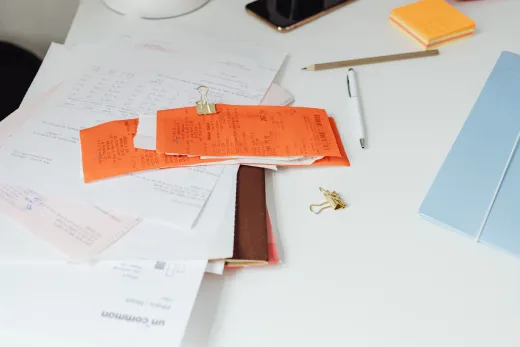
An invoice bill is a commercial document that records a sale and asks for it to be paid. The word you use depends on where you stand: the seller issues an invoice as a request for payment, while the buyer who receives the same document treats it as a bill to settle. The phrase invoice bill captures both sides at once. This guide explains what an invoice bill is, untangles it from a receipt and a statement, walks through its elements and the billing cycle, and shows how buyers handle a supplier bill in accounts payable.
Key takeaways
- An invoice and a bill are the same document seen from opposite ends of a sale, not two different things.
- A receipt confirms payment after the fact, and a statement summarises many invoices; neither replaces a bill.
- Every invoice bill needs the same core elements: numbering, dates, parties, line items, tax and a total.
- Buyers process a bill through accounts payable by matching it to the order, approving it and paying on time.
What is an invoice bill?
An invoice is a commercial document that records the sale of goods or services and requests payment for them. It names the seller and the buyer, carries a unique reference, itemises what was supplied, adds any tax, and states the total amount owed and the date it is due. That single document is the backbone of nearly every business transaction, because it is both the request to be paid and the record that the sale happened.
So where does the word bill come in? It is the same piece of paper or PDF, simply named from the buyer's point of view. When a supplier sends the document, they call it an invoice they have issued. When it lands on the buyer's desk, that buyer calls it a bill they have to pay. Nothing about the layout or the contents changes; only the perspective does. The phrase invoice bill exists because so many people meet the document from both directions and reach for both words.
Understanding that the two terms describe one thing removes a lot of confusion. You do not need a separate format for invoices and bills, a separate process, or separate software. You need one clear document that reads well whether the person holding it is chasing payment or approving it. The rest of this guide treats invoice and bill as the same object throughout, and reserves the finer distinctions for the documents that genuinely are different: the receipt and the statement.
Invoice vs bill vs receipt vs statement
Four words get mixed up constantly, and the confusion causes real errors: a customer pays the wrong figure, a receipt is treated as a demand, or a statement is settled twice. The quickest way to keep them straight is to ask what each document does and when it appears in the transaction. Here is the plain version.
| Document | Who sees it | What it does | When |
|---|---|---|---|
| Invoice | The seller's word | Requests payment for a sale | After delivery, before payment |
| Bill | The buyer's word | The same request, awaiting settlement | After delivery, before payment |
| Receipt | Both parties | Confirms payment has been made | After payment |
| Statement | Both parties | Summarises several invoices and the balance | Periodically, for an account |
Read the table top to bottom and the sequence makes sense. The invoice and the bill are the same request for payment, labelled by whoever is speaking. The receipt comes next, but only once money has actually changed hands; it is proof of settlement, not a demand, and issuing one before payment would be meaningless. The statement sits outside that single transaction altogether. Rather than asking for a specific amount, it gathers up every invoice, payment and credit on an account over a period and shows the running balance, so both sides can reconcile. Crucially, a customer pays against the individual invoices on a statement, never against the statement total as though it were a fresh bill.
When each term is used
Because the words carry a point of view, the one you choose usually signals which side of the deal you are on. A supplier writing to a customer will say "please find your invoice attached" and "the invoice is now overdue". The same supplier, receiving a demand from their own utility company, will grumble about "the electricity bill". Neither is wrong; they simply reflect who is asking and who is paying in each case.
In everyday speech, bill tends to attach to services and recurring charges you receive as a consumer: the phone bill, the water bill, the restaurant bill. Invoice leans more formal and more common in business to business trade, where a company issues invoices and expects them paid on terms. In accounting software the line is often drawn deliberately, with the money you are owed recorded as sales invoices and the money you owe recorded as bills. That split is a useful convention rather than a difference in the underlying document.
The practical takeaway is not to overthink the vocabulary. If a customer asks for a bill and you send a document titled invoice, you have given them exactly what they wanted. What matters far more than the word at the top is whether the document carries every element it needs, which is where we turn next.
The elements of an invoice bill
Whatever you call it, an invoice bill only works if it carries a fixed set of fields. Leave one out and you invite a query, a delay, or a payment that never quite arrives. These are the elements every invoice bill should contain, regardless of the business sending it:
- A clear label and unique number. The word "invoice" and a sequential reference so both parties can track and cite the document without ambiguity.
- Issue date and due date. When the bill was raised and the date by which payment is expected, both stated plainly.
- Seller and buyer details. Full trading names, addresses and, where relevant, tax registration numbers for each party.
- Itemised line entries. A description of every product or service supplied, with quantity, unit price and a line total.
- Tax, subtotal and grand total. Any sales tax or VAT shown on its own line, a net subtotal, and the final amount due.
- Payment terms and methods. How to pay, by when, and the bank or reference details the buyer needs to settle correctly.
Almost every one of these fields exists to remove ambiguity. A unique number stops two bills being confused. A due date sets a shared expectation instead of a vague hope. A separate tax line lets a value-added tax registered buyer reclaim the tax cleanly. For a full breakdown of how to lay these elements out, and worked templates you can copy, see our invoice bill format guide.
The billing cycle explained
An invoice bill is not a one-off event; it is one stage in a repeating cycle. Understanding that cycle helps both the seller who wants to be paid and the buyer who wants to control cash. The billing cycle is the predictable path a transaction follows from the moment an order is agreed to the moment the money settles and the books are closed.
In a typical business to business flow, the buyer raises a purchase order, the seller delivers the goods or services, and the seller then issues the invoice. The buyer receives that document as a bill, checks it, approves it, and pays by the due date. Once paid, a receipt or payment confirmation closes the loop, and any periodic statement reflects the settled balance. Each step has a document and a moment, and skipping one tends to create a gap that someone has to chase later.
For recurring arrangements, such as a subscription or a monthly retainer, the cycle repeats on a set date. The billing period defines what the invoice covers, the invoice date starts the clock, and the payment terms set how long the buyer has to pay. A tighter, more predictable cycle is the single biggest lever most businesses have over their cash flow, because a bill that goes out promptly and is paid on time keeps money moving rather than trapped in unpaid invoices.
How buyers treat a supplier bill in accounts payable
Flip the transaction around and the invoice becomes an incoming bill the buyer has to manage. This is the world of accounts payable, the function that records what a business owes its suppliers and makes sure each bill is paid correctly and on time. A supplier bill does not simply get paid on arrival; it runs through a short, disciplined process first.
The heart of that process is the three-way match. The accounts payable team lines up the incoming bill against the original purchase order and the delivery or goods received note. If the quantities, prices and items agree across all three, the bill is genuine and correct, and it can be approved. If they do not, the mismatch is flagged before any money leaves the account. This single check catches duplicate bills, overcharges and billing for goods that never arrived.
Approve on the match, not on the reminder. The most expensive mistake in payables is paying a bill because it looks urgent rather than because it has been matched to an order and a delivery. A bill that cannot be tied to a purchase order deserves a question, not a payment. Building the match into the process, rather than trusting a chasing email, is what stops duplicate and fraudulent bills being paid.
Once matched and approved, the bill is scheduled for payment by its due date, the money is sent, and the entry is cleared. Done well, this protects the buyer's cash and their supplier relationships at the same time, because suppliers paid reliably on terms stay willing to trade. Done manually across hundreds of bills, it becomes slow and error-prone, which is exactly the pressure that pushes teams towards automation.
Common invoice bill mistakes
Most billing problems are not exotic. They are the same handful of avoidable errors, repeated. Knowing them in advance is the cheapest way to keep your cash flow smooth, whether you are the one sending bills or the one paying them.
On the seller's side, the classic faults are a missing or duplicated invoice number, a vague line description that invites a query, a tax figure folded into the total with no breakdown, and a due date that is absent or unrealistic. Each of these turns a simple request for payment into a back and forth that delays the money. Sending the bill late is its own quiet mistake; an invoice that sits on someone's desk for a week before it is issued has already lost a week of the payment window.
On the buyer's side, the errors mirror those. Paying a bill without matching it to an order lets duplicates and overcharges slip through. Losing a bill in an inbox means a missed due date and a strained supplier. The common thread is that manual handling and scattered records create the gaps, and consistency closes them. A predictable format and a single place to store every bill remove most of these problems.
Automating invoices and bills
A spreadsheet and a template will carry a small business a long way. But every manual invoice still depends on someone remembering the next number, copying the right buyer details, calculating the tax, sending the document promptly and filing it where it can be found again. That holds at a few bills a month. At a few hundred, the small errors multiply and the chasing becomes a job in itself.
Automation removes that overhead on both sides of the transaction. For the seller, a platform generates each invoice in a fixed format, assigns the next number automatically, applies the correct tax, links the bill to its order and hands the figures to the accounts without re-keying. For the buyer, the same connected record lets an incoming bill be matched to its purchase order and delivery in seconds rather than minutes, then routed for approval and scheduled for payment. This is also the ground on which electronic invoicing is built, where structured, machine-readable bills flow between systems without anyone typing them out.
This is where a system such as ProcureWave earns its place. By tying quotes, purchase orders, invoices and payments into one connected record, it keeps every bill on the same format, enforces the match between order and invoice, and gives both buyer and seller a complete audit trail from first order to final settlement. The vocabulary stops mattering, because the document is consistent whether you call it an invoice or a bill, and the process runs the same way every time.
An invoice bill is a simple idea wrapped in confusing language: one document, two names, a fixed set of elements, and a predictable place in the billing cycle. Keep the elements complete, keep the receipt and the statement in their own lanes, and match every incoming bill before you pay it, and the whole cycle stays smooth. If you want to see how ProcureWave keeps every invoice and bill on one consistent, automated record, get in touch. For a deeper look at building the document itself, our sample invoice guide walks through a complete worked example.
Frequently asked questions
What is an invoice bill?
An invoice bill is a commercial document that records a sale and requests payment for it. The seller issues it as an invoice; the buyer who receives it calls it a bill. It is the same document viewed from two sides of the transaction, carrying a unique number, dated line items, any tax, and a clear total due. Our invoice guide covers each field in full.
What is the difference between an invoice and a bill?
There is no difference in the document itself, only in who is looking at it. The party selling raises an invoice as a request for payment. The party buying receives that document and treats it as a bill to settle. The phrase invoice bill simply reflects both perspectives at once, and the layout stays identical whichever word you use.
Is a bill the same as a receipt?
No. A bill asks for payment and is issued before money changes hands. A receipt confirms payment and is issued afterwards as proof the bill was settled. One opens the transaction and the other closes it, so a business normally sends a bill first and a receipt only once the amount has been paid.
How is a statement different from an invoice bill?
An invoice bill covers a single transaction and states one amount due. A statement is a periodic summary that lists several invoices, payments and the running balance across an account. A customer pays against invoices, not against a statement; the statement is a reminder and a reconciliation tool rather than a fresh demand for payment.
How do buyers process a supplier bill?
A buyer records the incoming bill in accounts payable, matches it against the original purchase order and any delivery note, checks the figures, routes it for approval and then schedules payment by the due date. Automation links each bill to its order so this match happens without manual keying, which is where a connected platform saves the most time.
Want to see this in your own numbers?
Book a tailored demo and we will show ProcureWave running on scenarios that match your business.
Get in touch