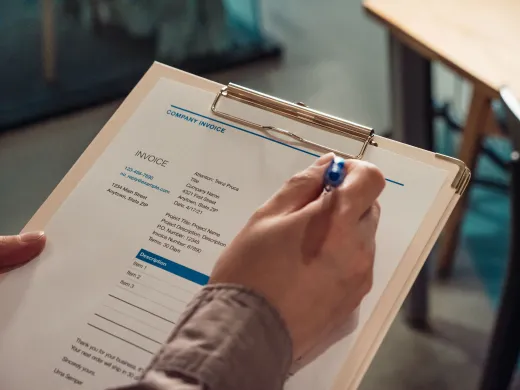
A PO invoice is one that quotes a valid purchase order, which means it can be checked by rules rather than by people. That single property changes how an accounts payable team works at volume. This guide takes the payables view rather than the buying view: how PO invoices arrive, how matching and tolerances behave in real life, which exceptions actually block payment and how to clear each one, what the touchless rate tells you, and how to keep supplier statements and month-end accruals honest when thousands of documents are moving through the queue every week.
Key takeaways
- An invoice is PO-backed only if the order number is valid, open and quoted at line level, not just typed in a header field.
- Capture quality decides everything downstream, so the channel mix of email, portal, scanning and e-invoicing is a strategic choice.
- Six exception types cover nearly every blocked invoice, and each has a different owner and a different fix.
- The touchless invoice rate is the honest headline metric, and accruals for received-not-invoiced keep the month-end close defensible.
What makes an invoice PO-backed
An invoice becomes a PO invoice when it carries a reference to a live purchase order that the buying organisation raised before the spend happened. That reference is the whole point. It ties the supplier's request for payment back to an approved commitment, with an owner, a budget line, a price and a quantity already agreed. Payables is then verifying that what arrived matches what was ordered, rather than asking from scratch whether the purchase should have happened at all.
In practice the bar is higher than a number printed somewhere on the page. For an invoice to behave as PO-backed, the order has to exist in your system, still be open, have remaining value or quantity available, and belong to the same supplier account the invoice was sent from. Ideally the supplier also quotes the order line, because a five line order billed as a single lump sum still needs a person to decide how to split it. Teams that push suppliers to quote line numbers, not just the order header, see their match rates climb without touching any technology.
Everything else is a non-PO invoice: utilities, rent, professional fees, expenses, and the long tail of purchases people made before anyone raised an order. Those documents are not wrong, but they cost far more to process because approval has to be gathered after the money is already committed. The broader discipline of handling both streams together is covered in our guide to vendor invoice management.
Why accounts payable teams prefer them
Accounts payable is a volume function. The work is not intellectually hard, but there is a great deal of it, and the cost per invoice is driven almost entirely by how many documents need a human decision. A PO invoice can be validated by comparison. A non-PO invoice needs someone to identify the right approver, chase them, interpret their answer and code the transaction. The first is a rule. The second is a conversation.
There is a control benefit too. When spend is committed through orders, the approval happens before money is owed, which is the only point at which the organisation can still say no. By the time an invoice lands the goods are usually consumed and the legal obligation exists. Approving at the order stage also produces clean commitment data, so finance can see what has been ordered but not yet billed, which is exactly what makes accrual accounting work at the close.
Suppliers benefit as well, even though the discipline feels like a burden to them. An invoice that matches is paid to terms without a query. Most late payment friction is not reluctance to pay, it is an invoice stuck behind a missing detail that nobody has been asked to supply. Telling suppliers plainly that a valid order number is the fastest route to payment converts more of them than any amount of policy language.
Capturing invoices at volume
Whatever happens later depends on how cleanly the document arrives. Most organisations run several channels at once, and it is worth being deliberate about the mix rather than letting it evolve by accident:
- Email intake. A single monitored mailbox that automatically creates an invoice record from the attachment. Cheap and universally acceptable to suppliers, but it invites duplicates, chase mail and PDFs of varying quality into the same queue.
- Supplier portal. Suppliers key or upload the invoice themselves against an order you have published. Data quality is the highest of any channel because the order is selected rather than typed, though smaller suppliers resist another login.
- Scanning and capture. Optical character recognition reads header and line data from PDFs and paper. Modern engines are accurate on layouts they have seen before, so the value comes from volume per supplier rather than from the technology alone.
- Electronic invoicing. Structured data passed machine to machine in an agreed format. No reading is involved because there is no document to read, which is why regulators in a growing list of countries are mandating it.
- Recurring and self-billing. For predictable arrangements the buyer generates the invoice from the receipt, removing the supplier document from the process entirely.
A sensible target is to move the twenty or so suppliers who send the most documents onto the most structured channel available, and leave everyone else on email. That concentrates effort where the volume actually is.
Matching rules and tolerances in practice
Matching is the comparison that decides whether an invoice can proceed without a person. Two-way matching compares invoice to order on price and quantity. Three-way matching adds the goods receipt so nothing is paid before it is booked in. Some organisations add an inspection or acceptance step for regulated or high-value categories, giving a four-way check. The right rule depends on the category rather than the supplier: goods deserve three-way, services and subscriptions usually cannot support it because nothing physical is received.
Tolerances are where the theory meets reality. Exact matching sounds rigorous, but it produces a flood of exceptions over rounding, freight, currency conversion and part deliveries, and a team drowning in trivial holds stops looking carefully at any of them. Sensible practice sets a percentage tolerance and an absolute cap together, so a two per cent variance is accepted only up to a fixed money value. Quantity tolerance is usually tighter than price tolerance, and under-delivery is treated differently from over-delivery because only one of them costs you money you did not agree to spend.
Review your tolerances every year, and look at what they let through. Tolerances set once and forgotten drift out of line with inflation and with your average order value. Sample the invoices that passed inside tolerance and confirm the accepted variances were genuinely immaterial. If a single supplier is consistently invoicing just inside the limit, that is a pricing conversation, not a matching problem.
The exceptions that block payment
Nearly every held invoice falls into one of six categories. Treating them as a single undifferentiated queue is the most common reason exception backlogs never clear, because each type has a different owner and a different fix. Splitting the queue by reason code and routing each stream to the person who can actually resolve it is usually worth more than any additional automation.
| Exception | What it means | Who clears it | How to fix it |
|---|---|---|---|
| No PO quoted | The invoice carries no order reference at all. | Requisitioner | Find the order if one exists; if not, route for manual approval and log the policy breach. |
| Wrong or closed PO | The number is invalid, belongs to another supplier or the order is fully consumed. | Buyer | Correct the reference, or reopen and amend the order if further supply was genuinely agreed. |
| Price variance | The unit price exceeds the ordered price beyond tolerance. | Buyer or category owner | Confirm the agreed price, then amend the order or ask the supplier for a credit note. |
| Quantity variance | More units invoiced than ordered or received. | Receiving site | Check for an unbooked or partial delivery, then correct the receipt or reject the excess. |
| No receipt | Goods have not been booked in, so three-way matching cannot complete. | Receiving site | Chase the receipt; investigate whether delivery actually occurred before releasing anything. |
| Suspected duplicate | The same supplier, number, date or amount already exists on the ledger. | Accounts payable | Compare against the original posting, cancel the copy and record the reason to protect the audit trail. |
Two habits make the difference. Put an age on every exception and report the oldest, not just the count, because a hundred fresh holds are healthier than ten that have sat for six weeks. And feed the reasons back upstream: if one site generates most of the missing receipts, that is a training issue at the goods-in desk, not a payables issue.
The touchless invoice rate
If you track a single number, track the share of invoices that arrive, match, post and pay without any human intervention. The touchless rate is honest in a way that cost per invoice is not, because it cannot be flattered by moving work to a shared service centre or a different budget line. It also drives most of the other measures you care about: cycle time, exception volume, overtime at the close and the proportion of early payment discounts you actually capture.
Touchless rate
Invoices processed end to end with no manual step, expressed as a percentage of total volume.
PO compliance
The share of addressable spend that was ordered before it was invoiced. The ceiling on your touchless rate.
Cycle time
Days from invoice receipt to approval for payment, measured from arrival rather than from posting.
Exception rate
Blocked invoices as a share of volume, broken down by reason code so the causes stay visible.
Measure the touchless rate from the moment the document arrives, not from the moment it enters the ledger, or you will quietly exclude the manual keying that happens before the clock starts. And read it alongside PO compliance, because no amount of matching sophistication will help if half your spend never had an order in the first place. Platforms such as ProcureWave connect the requisition, the order, the receipt and the invoice in one record, which is what makes the whole chain measurable rather than merely automated in parts. Our comparison of procure to pay software sets out what to look for when you evaluate options.
Supplier queries and statement reconciliation
Supplier chase mail is a symptom, not a workload. Every query means someone outside your organisation cannot see the status of an invoice you already hold, so they ask. Publishing status to a portal, or simply sending an automatic acknowledgement when an invoice is received and another when it is scheduled for payment, removes most of that traffic. The queries that remain are usually genuine disputes worth a person's attention.
Statement reconciliation is the periodic check that your ledger and the supplier's agree. Ask key suppliers for a statement monthly, compare open items, and investigate anything on their statement that is not on yours. It is unglamorous work that catches real problems: invoices sent to a personal mailbox and never registered, credit notes never applied, duplicate payments, and supply against orders nobody recorded.
Month-end accruals for received not invoiced
Goods received but not yet invoiced represent a liability the business has incurred without a document to show for it. If nothing is done, the cost lands in whichever period the invoice happens to arrive, which distorts both months. The accrual for received-not-invoiced fixes this by recognising the cost in the period the goods arrived, valued at the order price against the booked receipt, then reversing when the invoice posts.
Three things make the accrual reliable, and all three are ordinary discipline rather than accounting cleverness. Receipts must be booked promptly, because a delivery recorded a week late falls into the wrong period. Orders must be closed when they are complete, or you will accrue forever against residual quantities nobody will ever bill. And the ageing of the balance must be reviewed, since anything received months ago and still unbilled is either a lost invoice or a receipt that should never have been made. Where orders, receipts and invoices share one record, this report writes itself.
Building a process that scales
Volume rewards structure. The teams that process tens of thousands of invoices calmly are rarely the ones with the most sophisticated technology; they are the ones where purchase order compliance is high, supplier master data is clean, tolerances are set deliberately, exceptions are split by reason and owner, and the touchless rate is watched every month. Automation then amplifies a process that already works instead of industrialising a mess.
Start by measuring what you have. Take a month of invoices, sort them into PO-backed and non-PO, then sort the blocked ones by exception reason. That single exercise almost always reveals that a small number of suppliers, sites or categories generate most of the pain. Fix those first.
If you want to see how ordering, receiving and payables behave when they sit on one connected record, the ProcureWave solution was built for exactly this shape of work. When you are ready to talk it through with your own numbers rather than a generic demo, our team is happy to have that conversation.
Frequently asked questions
What is a PO invoice?
A PO invoice is a supplier invoice that quotes a valid purchase order number and can therefore be matched automatically against that order and, where goods are involved, against the receipt. Because the commitment was approved before the spend happened, accounts payable does not need to hunt for a manual approver. Anything without a usable PO reference is a non-PO invoice and follows a slower, people-driven route instead.
What is the difference between a PO invoice and a purchase order?
The purchase order is the buyer's document, issued first, saying what will be bought and at what price. The invoice is the supplier's document, issued after supply, asking to be paid for it. They carry overlapping data on purpose so the two can be compared line by line. Our companion piece on the purchase order and invoice sets out the differences field by field.
What is two-way and three-way matching?
Two-way matching compares the invoice with the purchase order on price, quantity and line detail. Three-way matching adds the goods receipt, so the invoice only passes if the goods were actually booked in. Services and subscriptions are usually matched two ways because there is nothing physical to receive. Most accounts payable teams run both rules and choose per category.
Why do PO invoices still go on hold?
Usually for one of six reasons: no purchase order was quoted, the wrong purchase order was quoted, the price differs from the order, the quantity differs from the order, no receipt has been booked, or the invoice is a duplicate. Each has a distinct owner and a distinct fix, so treating them as one undifferentiated exception queue is what keeps them unresolved.
What is a good touchless invoice rate?
The touchless rate is the share of invoices that post and pay with no human intervention at all. Teams starting out often sit in the twenties or thirties. Well run functions with strong purchase order compliance and clean supplier master data reach seventy per cent or more. The number matters less than the trend, because every point you gain is capacity returned to the team.
Want to see this in your own numbers?
Book a tailored demo and we will show ProcureWave running on scenarios that match your business.
Get in touch