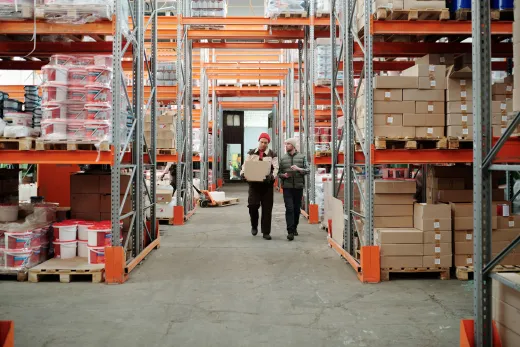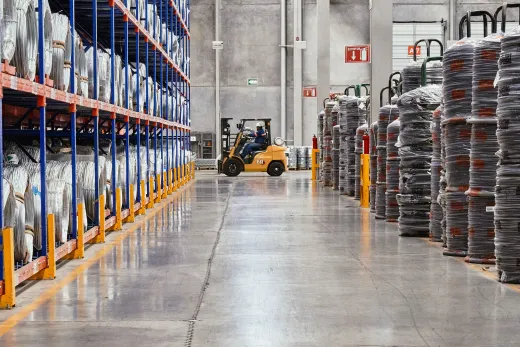
A warehouse is not a storage problem. It is the point where every plan your business made about supply, demand and cash gets tested against physical reality. Stock either exists where the system says it does, or it does not. Orders either go out complete and on time, or they do not. This guide walks through the core processes, the layout and software decisions behind them, the numbers worth watching, and the often overlooked link back to procurement that makes the whole chain reconcile.
Key takeaways
- Warehouse work is six repeatable processes plus counting; almost every problem traces back to one of them being informal.
- Slotting and layout decide travel time, and travel time is the single largest cost in most manual operations.
- A WMS earns its place by directing work and enforcing scanning, not by holding stock figures.
- Accurate, timely goods receipt is what allows procurement and finance to close the three-way match without chasing.
Where the warehouse sits in the supply chain
Every supply chain has a rhythm mismatch built into it. Suppliers ship full pallets on their own production schedule; customers order in ones and twos whenever they feel like it. The warehouse is the shock absorber between those rhythms, and its job is to hold the difference at the lowest cost and the highest reliability it can manage.
That framing tells you what to optimise. A warehouse judged only on storage cost fills every rack and grinds to a halt on picking. One judged only on speed holds too much stock. The useful target sits between: enough inventory to serve demand, held in a layout that makes retrieving it quick, with records accurate enough that planners and buyers trust them. Our supply chain management guide covers how that balance connects upstream to sourcing and downstream to fulfilment.
Logistics textbooks describe warehousing as one node in a network. On the ground it behaves more like a factory: input arrives, a sequence of operations is performed, and finished work leaves through a different door. Treating it as a production process rather than a storage cupboard makes everything else in this guide easier to apply.
The core processes, end to end
Strip away the industry variation and warehouse work is a small number of repeatable processes. Each hands off to the next, and a weakness anywhere propagates forward: receiving errors become picking errors, and picking errors become customer complaints. This is the cycle in order.
- Receiving. Unload, check the delivery against the purchase order, inspect condition and quantity, and record what actually arrived. The last practical moment to reject a short or damaged shipment.
- Putaway. Move goods to a storage location and record it. Directed putaway, where the system tells the operator where to place the item, beats letting people choose the nearest empty space.
- Storage and slotting. Hold stock so it is protected and fast movers stay close to despatch. Slotting is reviewed periodically, not set once.
- Picking. Retrieve items against an order. Most labour is consumed and most accuracy won or lost here, so scanning discipline pays back fastest at this step.
- Packing and despatch. Check the pick, pack for transit, produce labels and paperwork, stage by carrier and load. A packing check is the cheapest error trap you have.
- Returns. Receive goods coming back, decide whether they are resaleable, then restock, repair or dispose. The process most often left informal, and the one that quietly corrupts stock records.
- Cycle counting. Count a subset of locations continuously rather than shutting down once a year. It finds discrepancies while the cause is still traceable.
Write these down for your own site with an owner against each. The exercise usually surfaces a process nobody formally owns, and that is almost always where accuracy is leaking.
Layout and slotting logic
In a manual operation, walking is the biggest single consumer of labour. Studies of order picking routinely put travel at more than half of total pick time, so layout decisions affect cost more than almost any equipment purchase. The goal of slotting is to reduce distance travelled per line picked.
The standard starting point is velocity based slotting. Rank items by how often they are picked, not by how much stock you hold, and put the fastest movers in the golden zone: waist to shoulder height, close to the despatch end. Slow movers go high, low or far. A small proportion of lines generates most picks, so reslotting the top few hundred items alone cuts travel noticeably.
Layer three refinements on top. Group items that are frequently ordered together so a single trip collects both. Respect physical constraints: heavy items low, hazardous goods in their designated area, temperature sensitive stock in the right zone. And keep a buffer of empty locations, because a warehouse running above roughly ninety percent occupancy loses the flexibility to putaway efficiently and people start dumping stock wherever it fits.
Slotting is not a one off project. Demand shifts seasonally and ranges change, so review the fast mover list quarterly and reslot the top movers. It is dull work with a better return than most capital projects.
What a WMS actually does
A warehouse management system is usually sold as software that tracks stock. That undersells it, because tracking stock is the easy part. What a WMS really provides is work direction: it decides what happens next, by whom, in what sequence, and refuses to close the task until the operator has scanned proof it was done correctly.
In practice that shows up as directed putaway and directed picking, batch and wave planning so pickers collect several orders in one trip, location and licence plate tracking so every pallet has an identity, lot and serial control where traceability matters, cycle count scheduling, and task interleaving that gives an operator a putaway on the way back from a pick instead of an empty walk.
The distinction from an inventory module matters when choosing systems. An inventory system holds quantities for planning and finance, which is enough for many businesses with a single stockroom. A WMS becomes worthwhile with multiple storage locations, several pickers working at once, or traceability obligations. The comparison in our inventory management in supply chain guide is a good place to work out which side of that line you sit on.
Whatever you choose, the integration points are the same and they are where implementations succeed or fail: purchase orders in from procurement, goods receipts out to finance, stock levels shared with planning, and despatch confirmations out to customer service and carriers.
Barcodes, RFID and mobile scanning
Everything above depends on identifying an item without a human reading a label and typing a code. Manual entry produces errors at a rate that is easy to underestimate, and each one costs far more to unpick than the keystroke saved.
Barcodes
Cheap, universal and reliable. One dimensional codes carry an item number; two dimensional codes carry batch, expiry and serial data as well. For most operations this is the right default.
RFID
Tags read without line of sight and many at once, which suits pallet level tracking, high value goods and fast moving retail. Tag cost and read reliability around metal and liquid are the practical limits.
Mobile devices
Rugged handhelds, wearable ring scanners or ordinary smartphones. The device matters less than whether the task can be completed entirely on it, without a trip back to a desktop.
Voice and light picking
Voice directed picking keeps both hands free and suits high volume case picking. Pick to light suits dense, fast lines. Both are add-ons to a WMS rather than replacements for one.
The rule that matters more than the technology choice: scan at every point where custody changes. Receipt, putaway, pick, pack, despatch. Skipping one of them to save a few seconds creates a gap in the record that someone will spend an hour reconstructing later.
Labour planning and productivity
Labour is usually the largest controllable cost in a warehouse and the least evenly demanded. Order volume peaks by day, by hour and by season, while headcount is fixed. Good labour planning is mostly about shaping work to match that curve rather than pushing people harder.
Forecast workload in units of work rather than orders: lines to pick, pallets to receive, cartons to pack. Convert those into hours using your own observed rates. Then flatten the peaks, by booking inbound deliveries into dock slots so three lorries do not arrive at once, and by pulling forward picking for orders with a later cut off.
Cross training is the other lever. A team where most people can receive, pick and pack moves to wherever the queue is longest; a team of specialists cannot. Publish performance by team rather than by individual, because league tables tend to buy speed at the cost of accuracy and safety.
Measure the work, not just the hours. A warehouse that reports only total hours worked cannot tell whether a busy week was efficient or wasteful. Lines picked per hour, cases received per hour and orders packed per hour take a few weeks to establish and immediately change the quality of every staffing conversation you have afterwards.
Accuracy, service and safety KPIs
Warehouse measurement goes wrong in two directions: too many metrics nobody acts on, or one productivity number that hides deteriorating quality. A small balanced set works better, and most operations can produce these within a month.
| KPI | What it measures | Typical calculation | Why it matters |
|---|---|---|---|
| Inventory record accuracy | Agreement between system and shelf | Locations counted correct divided by locations counted | Every plan downstream assumes the record is true |
| Picking accuracy | Quality of outbound work | Errors per thousand lines picked | Pick errors become returns, credits and lost customers |
| On time in full | Service delivered to the customer | Orders complete and on the promised date divided by total orders | The single number customers actually feel |
| Dock to stock time | Speed of receiving and putaway | Hours from arrival to available for picking | Stock you cannot find yet is stock you cannot sell |
| Lines per hour | Labour productivity | Lines picked divided by hours worked | Basis for realistic staffing and cost per order |
| Damages | Handling quality | Value of damaged stock divided by value handled | Rising damage usually signals congestion or rushed work |
| Recordable incidents | Safety performance | Incidents per period, normalised by hours worked | Leading indicator that an operation is running too hot |
Review them weekly as a set. When productivity rises while accuracy and damages worsen, you have not improved anything; you have moved cost from the warehouse to customer service.
Goods receipt, procurement and the three-way match
The most underrated link in warehouse management runs backwards into buying and finance. The receipt recorded at the dock is the evidence that an order was fulfilled, and the middle document of the three-way match: purchase order, goods receipt note, supplier invoice.
If those three agree, an invoice can be approved and paid with no human investigation. If the receipt is entered late, in round numbers, or by someone copying the delivery note rather than counting, the mismatch surfaces weeks later in accounts payable, when the pallet has been broken down and nobody can remember what arrived. Our goods receipt note guide covers the document itself and the fields worth insisting on.
Three habits make this work. Receive against the purchase order rather than the delivery note, so discrepancies are visible immediately. Record short and damaged quantities as they are instead of adjusting them quietly later. And close the receipt the same day, because inventory management depends on the record being current, not eventually correct.
This is the seam where ProcureWave tends to be useful. Approved purchase orders arrive at the warehouse as expected deliveries, receipts are captured against them line by line, and the matched result flows to finance without anyone rekeying it. The warehouse gets a shorter receiving process and procurement gets accurate data on which suppliers deliver what they promised.
Automation options, in a sensible order
Automation covers a wide range, and the marketing rarely distinguishes a conveyor from a fleet of autonomous robots. Think about it by how much of the process you are handing over. Conveyors and sortation move goods between fixed points. Automated storage and retrieval brings goods to a stationary picker. Mobile robots transport carts or carry mobile shelving to workstations. Palletising and packing machines handle the end of the line. Each has a different capital cost and tolerance for change.
Sequence matters more than selection. Get scanning discipline and cycle counting working first, because automation depends utterly on accurate location data. Then fix slotting, which is free and often removes the bottleneck you were about to spend money on. Only then automate the movements that are genuinely repetitive, high volume and stable.
Be honest about volume too, because most automation cases rest on utilisation and idle equipment rarely pays back. For many mid sized operations the better investment is software and process: directed work, reliable receipts, clean data and a slotting review, which together often deliver a double digit productivity gain for a fraction of the cost.
If you are working out where your own warehouse loses time, the receiving end is usually the place to start, because errors there travel all the way through to the invoice. We are happy to talk through how ProcureWave connects purchase orders, goods receipts and matching. Get in touch and we will walk through it with your process, not a demo script.
Frequently asked questions
What is warehouse management in the supply chain?
Warehouse management is the control of everything that happens to goods between the moment they arrive at your door and the moment they leave it: receiving, putaway, storage, picking, packing, despatch, returns and counting. In supply chain terms it is the buffer that absorbs the mismatch between how suppliers deliver and how customers order. Done well it is invisible. Done badly it shows up as late orders, wrong picks and stock that exists in the system but not on the shelf.
What is the difference between a WMS and an inventory system?
An inventory system tells you how much of an item you own. A warehouse management system tells you where each unit is, who touched it, in what sequence work should be done and whether the last count agreed with the record. Inventory answers quantity questions for planning and finance; a WMS answers location and task questions for the people on the floor. Smaller operations often run both jobs from one platform, and our inventory management guide explains where the line usually falls.
How does goods receipt connect back to procurement?
The goods receipt note created at the dock is the second document in the three-way match. The purchase order says what was ordered, the receipt says what actually arrived and the supplier invoice says what is being charged. If the receipt is captured accurately and on time, finance can match and pay without chasing anyone. If it is captured a week late or approximated, every invoice query becomes an investigation.
What are the most useful warehouse KPIs to start with?
Four cover most of the ground: inventory record accuracy from cycle counting, picking accuracy measured in errors per thousand lines, on time in full despatch against promised dates, and a labour measure such as lines picked per hour. Add a safety measure, usually recordable incidents, because a warehouse that is quietly running hot will show up there before it shows up anywhere else.
When is warehouse automation worth the investment?
When volume is high, stable and predictable enough that the equipment stays busy, and when the process it automates is already working manually. Automating a broken process just makes the same mistakes faster. Most operations get more return from fixing slotting, scanning and counting discipline first, then automating the two or three movements that remain genuinely repetitive.
Want to see this in your own numbers?
Book a tailored demo and we will show ProcureWave running on scenarios that match your business.
Get in touch