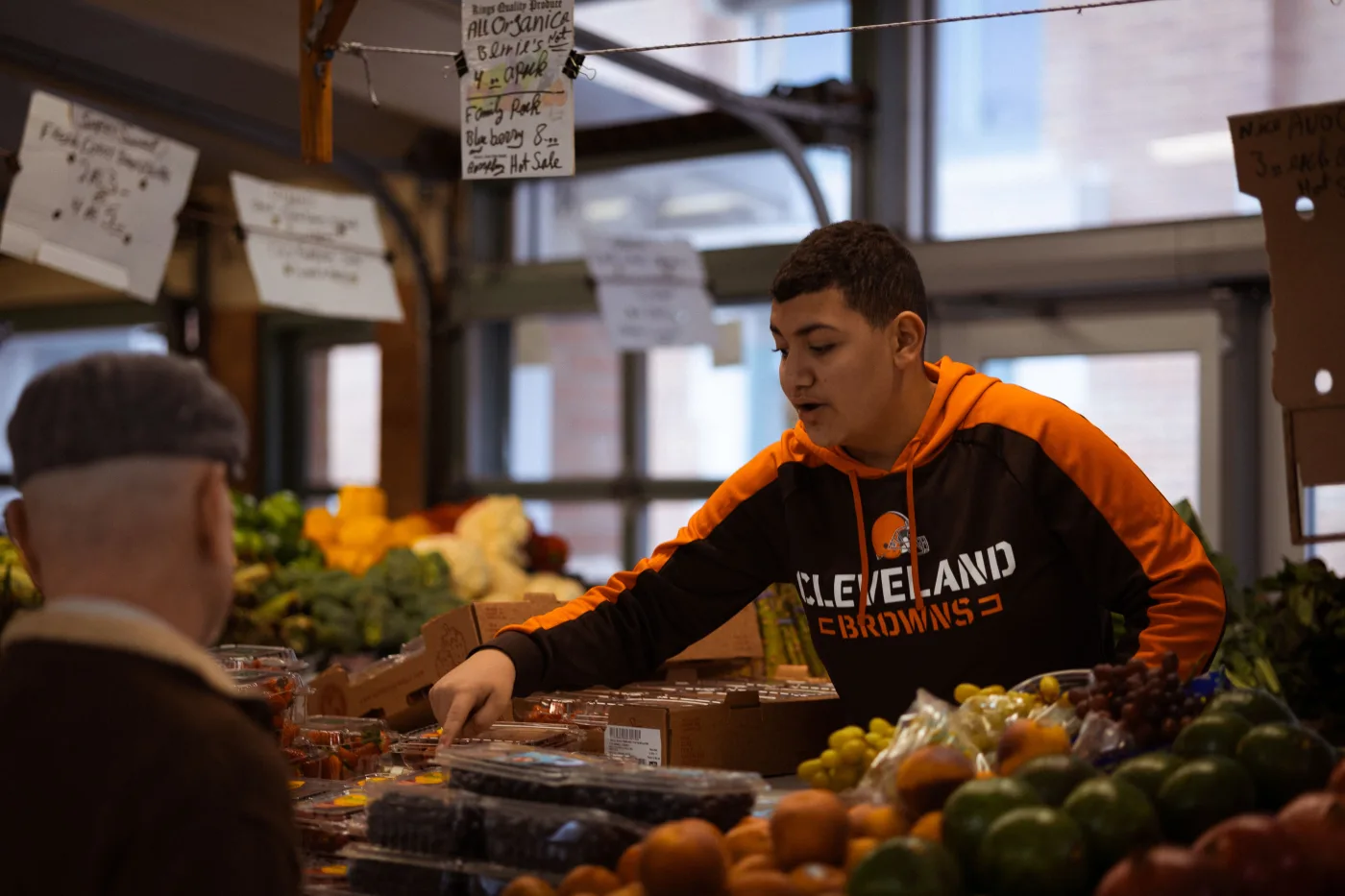
"Market vendor" describes two people who rarely meet. One stands behind a trestle table at six in the morning setting out produce; the other uploads photographs to a marketplace listing and waits for orders. Both rent access to somebody else's customers, both live on thin margins, and both are increasingly asked to behave like proper suppliers when a business wants to buy from them. This guide covers the traditional stallholder, the online marketplace seller, and what each means for organisations that buy.
Key takeaways
- A market vendor sells from a rented pitch or listing rather than premises of their own.
- Licences, pitch fees and tax duties vary by locality, so always confirm with the operator and local authority.
- Physical and online market vendors face the same core problem: fees plus footfall risk against a thin margin.
- Buyers should test identity, invoicing, insurance and reliability before treating any small vendor as a supplier.
What a market vendor actually is
Strip away the setting and a market vendor is a trader without premises. They sell directly to the public from a space they do not own, on terms set by whoever runs the market. That definition has held for centuries, from the licensed hawkers and pedlars of medieval towns to the seller who ships a phone case from a bedroom today.
The word "vendor" itself is broader than the market context. In a business setting it covers any party that supplies goods or services for payment, which is why the same term appears in purchase orders and in conversations about a Saturday cheese stall. If you want the full range of usage, our guide to the meaning of vendor unpacks it properly. Here we are interested in the two readings people actually search for.
Market stallholder
Sells face to face from a pitch in a physical market, indoor hall, farmers market or street trading area. Rents the pitch, transports stock, handles cash and cards, and packs down at the end of the day.
Marketplace vendor
Sells through an online platform that hosts the storefront, processes payment and supplies traffic. Rents visibility through commission and advertising rather than a pitch fee.
Wholesale market trader
Sells in bulk to other traders and to caterers rather than to the public, often at early morning produce, fish or flower markets that close before retail hours begin.
Casual or event vendor
Trades occasionally at fairs, festivals and seasonal markets, paying per event rather than holding a permanent pitch.
The traditional stallholder: the working day
A physical market vendor works a day far longer than the trading hours suggest. Stock is loaded the night before, the van arrives while it is still dark, and the pitch has to be built before the first customer appears. Display matters more than most people expect: goods at eye level, prices legible from three paces, the best produce at the front. Setup and pack down easily add three hours to a six hour trading day.
The commercial relationship sits with the market operator, which may be a local authority, a private company or a community association. The operator allocates pitches, sets trading hours, enforces the rules on what may be sold and collects the fee. Permanent traders usually hold an agreement for a season or a year and keep the same spot; casual traders take whatever is unallocated at a higher daily rate.
Licensing is where generalisation becomes dangerous. Depending on the jurisdiction, a market vendor might need a street trading consent, a market trader permit issued by the operator, registration of the business with the tax authority, a separate food business registration, and specific permissions for regulated goods such as alcohol or knives. The pattern is common; the detail is local. Treat any list you read online, including this one, as a prompt to ask the market operator and the local authority rather than as an answer.
Pitch fees follow simple logic. You pay for footfall. A covered pitch by the main entrance on the busiest trading day is the most expensive space in the market, and an open pitch at the far end on a quiet Tuesday is the cheapest. Fees are quoted per day or per week and may or may not include electricity, overnight storage, waste collection and public liability cover arranged by the operator. Two apparently similar markets can differ by half again once the extras are counted.
Sourcing stock and defending the margin
Where the stock comes from defines the business. Produce traders often buy at a wholesale market in the early hours, which gives them freshness and price flexibility but means committing cash before a single sale. Craft and food producers make what they sell, so their constraint is production time rather than purchasing. Traders in general goods buy from wholesalers, clearance lots or importers, where the margin depends entirely on how well the initial buy was judged.
The arithmetic is unforgiving. Take the retail price, subtract cost of goods, then subtract the pitch fee, fuel, parking, packaging, card processing and the value of unsold perishable stock. What remains has to pay the trader for a twelve hour day. This is why experienced vendors obsess over sell through rate rather than headline margin: a fifty per cent margin on goods that only half sell is not a fifty per cent margin at all.
Buying decisions therefore cluster around risk. Perishables are bought tight and sold hard, with prices cut late in the day rather than carried home. Non perishables can be bought deeper, since the only cost of carrying them is storage and cash tied up. It is the same discipline that formal retail businesses build entire systems to enforce.
Taking payment and keeping records
Markets used to run on cash and many still do, but card acceptance has become close to mandatory. Portable readers made it practical, and customers who cannot pay by card increasingly walk away rather than find a cash machine. Most vendors now run both, which means reconciling two payment streams every trading day.
- Cash. Immediate, universally accepted and free of processing fees, but it requires a float, secure handling, a banking routine and self discipline about recording every sale.
- Card and contactless. Faster queues, higher average basket and an automatic transaction record, offset by a percentage fee per sale and dependence on a mobile signal.
- Mobile and QR payments. Popular in many markets worldwide and cheap to accept, though the dominant scheme differs sharply by country.
- Invoiced sales. Where a vendor supplies a restaurant, office or event, payment moves to terms and the vendor needs to issue a proper invoice and chase it.
Record keeping is where casual trading and real business part company. A vendor who logs daily takings by payment type, keeps purchase receipts and separates business money from personal money can prove income, claim legitimate costs, register for tax correctly and, crucially, satisfy a business customer's finance team. One who cannot will always be limited to cash sales to the public.
Seasonality, weather and the other risks
Market trading is seasonal in a way that surprises newcomers. Outdoor markets in most climates have a long quiet stretch and a short intense peak, typically around holidays and summer events. Christmas or festival markets can generate a disproportionate share of annual takings in a few weeks, which means stock and cash have to be planned months ahead.
Weather is the daily version of the same risk. Rain does not merely reduce footfall, it changes what people buy and how long they linger. Vendors who survive plan for it: covered stock, a product mix that is not all weather dependent, and enough cash reserve to absorb a washed out weekend without panic selling.
The online marketplace vendor
The second reading of "market vendor" is the seller on an online marketplace. The platform provides the storefront, the payment processing, the dispute handling and, most valuably, the traffic. In exchange it takes a listing or subscription fee, a commission on each sale, a payment processing charge and, in practice, advertising spend, because organic visibility alone rarely fills a shop.
The pitch fee has become a percentage, and it behaves differently. A physical pitch costs the same whether you sell nothing or sell out, so a good day is hugely profitable. A marketplace commission scales with revenue, so the ceiling is lower but the downside is softer. Meanwhile the work shifts: no early start and no rain, but packing, postage, returns, review management and the constant risk that a policy change or an algorithm update removes your visibility overnight.
The dependency is the real story. A marketplace vendor does not own the customer relationship and can be suspended by a party whose decision is not negotiable, which is why serious sellers eventually build a direct channel alongside the platform.
Comparing the two vendor types
| Factor | Physical market vendor | Online marketplace vendor |
|---|---|---|
| Cost of access | Fixed pitch fee per day or week | Variable commission plus listing and advertising costs |
| Setup investment | Stall, vehicle, display, stock, float | Photography, listings, packaging, stock |
| Customer contact | Direct and face to face | Mediated by the platform |
| Reach | Local footfall on trading days | National or international, always open |
| Main daily risk | Weather, footfall, unsold perishables | Ranking changes, policy suspension, returns |
| Payment | Cash and card, settled immediately | Platform payout on a settlement cycle |
| Fulfilment work | Transport, setup, pack down | Picking, packing, postage, returns handling |
| Compliance focus | Trading permit, food hygiene, on site insurance | Product listings, consumer rights, distance selling rules |
| Selling to businesses | Local and relationship led | Possible but constrained by platform invoicing |
Many vendors now run both. The stall generates cash, feedback and local reputation; the listing generates reach and sells on the days the market is closed. The combination is more resilient than either alone, provided the vendor keeps one set of books.
What buyers should check before purchasing
Organisations buy from market and marketplace vendors more often than their policies admit: catering teams buy produce, offices buy event supplies, departments order from listings because it is quick. That is fine, but the vendor still has to survive contact with finance and audit.
Establish who you are actually paying before the first order, not after the first invoice query. Confirm the legal trading entity behind the stall or the storefront, check that the bank details belong to that same entity, and make sure the invoice you receive carries the details your tax and accounting rules require. A friendly relationship with the person on the stall is not the same as knowing who your organisation has contracted with.
Beyond identity, the checks are proportionate to what you are buying. Ask for evidence of public liability insurance if the vendor will be on your site, and product liability cover if you are reselling or serving what they supply. Where food is involved, ask about hygiene registration and rating, allergen information and temperature control during transport. For manufactured goods, ask about applicable safety marking and who holds responsibility for it. Requirements differ by jurisdiction and product, so treat these as questions to raise rather than boxes that are identical everywhere.
Reliability is the check people skip. A vendor who is excellent on a Saturday may not be able to deliver at seven on a Tuesday morning, three weeks running, in the volume you need. Test with a small recurring order before you build a schedule around them. Record the outcome somewhere durable rather than in one buyer's memory, which is precisely what a structured view of your vendor companies is for.
From stall to supplier: what small vendors can learn
Plenty of small vendors would happily supply businesses and never get asked, because the buyer cannot make the paperwork work. The gap is rarely about quality. It is about the small set of things a buying organisation needs before it can raise a purchase order at all: a registered legal identity, a bank account in the business name, an invoice that states the entity, address, tax registration where applicable, a reference number and clear payment terms.
After that come the questions that any formal procurement process asks. Can you supply consistently to an agreed specification? What happens when you cannot? Do you hold the insurance that our contract requires? Can you accept payment thirty days after invoice rather than on the day? A vendor who can answer these in writing moves from casual supplier to approved supplier, and approved suppliers get repeat orders instead of one off purchases.
The commercial upside is significant. Business customers order predictably, buy in larger units, pay by transfer and rarely haggle. The trade off is administrative discipline, and vendors who accept it usually find their weekday revenue stops depending on the weather.
On the buying side, the same shift is what turns scattered small purchases into a managed supply base. If your organisation is trying to bring informal vendors into a process that finance and audit can live with, ProcureWave keeps the identity, documents, insurance dates and order history for every supplier in one place, from a single market trader to a national distributor. Have a look at our procurement solution, or talk to us about how your current vendor records could be tidied up without adding work for the people doing the buying.
Frequently asked questions
What is a market vendor?
A market vendor is anyone who sells goods from a pitch in a market rather than from a fixed shop of their own. The term now stretches to cover sellers who trade from a listing on an online marketplace, because the economics are similar: you rent access to somebody else's footfall, you compete with neighbouring sellers on price and presentation, and you keep whatever margin survives the fees.
Do market vendors need a licence?
Usually yes, though the form varies enormously by country and even by town. Most places require some combination of a street trading or market trader permit, registration of the business for tax, and a food hygiene registration if you handle food. Because the rules are set locally, the only reliable answer comes from the market operator and the local authority that licenses the site.
How much does a market stall cost?
Pitch fees are normally charged per day or per week, with casual traders paying more per day than permanent tenants who commit to a season. Prime positions near entrances cost more than back rows, covered halls cost more than open ground, and busy weekend days cost more than quiet weekdays. Ask what the fee includes, since power, storage and waste disposal are often billed separately.
Is selling on an online marketplace easier than running a market stall?
It is different rather than easier. You lose the weather, the early start and the physical setup, but you gain packing, postage, returns, review management and a fee structure that quietly takes a large slice of each sale. Both models reward the same discipline: knowing your true cost per unit sold and defending it. That discipline is what turns a trader into a genuine vendor business.
What should a company check before buying from a market or marketplace vendor?
Confirm the legal identity of the trading entity, get a compliant invoice with the correct tax details, check public liability insurance and any product or food safety documentation that applies, and test reliability with a small order before committing to a recurring one. Small vendors can be excellent suppliers, but the paperwork has to satisfy your finance and audit teams.
Want to see this in your own numbers?
Book a tailored demo and we will show ProcureWave running on scenarios that match your business.
Get in touch